

The time left until 2:20 depends on the clock in front of you right now. Subtract the current time from 2:20 and you have your answer. At 1:50, you wait 30 minutes. At noon, you wait 2 hours and 20 minutes.
It works for both AM and PM. This guide shows the exact steps, a handy chart, and fixes for the mistakes that trip people up. You will also learn how to set a countdown so you never need to do the math again.
Quick Facts About the 2:20 Countdown
The fastest answer is one subtraction: 2:20 minus the current time. Here are the key facts in one place.
| Detail | Fact |
| Core formula | 2:20 minus the current time |
| 2:20 AM in 24 hour time | 02:20 |
| 2:20 PM in 24 hour time | 14:20 |
| 2:20 AM in minutes after midnight | 140 |
| 2:20 PM in minutes after midnight | 860 |
| Gap between 2:20 AM and 2:20 PM | 12 hours |
| Longest possible wait | 23 hours 59 minutes |
How Long Until 2:20 Right Now?
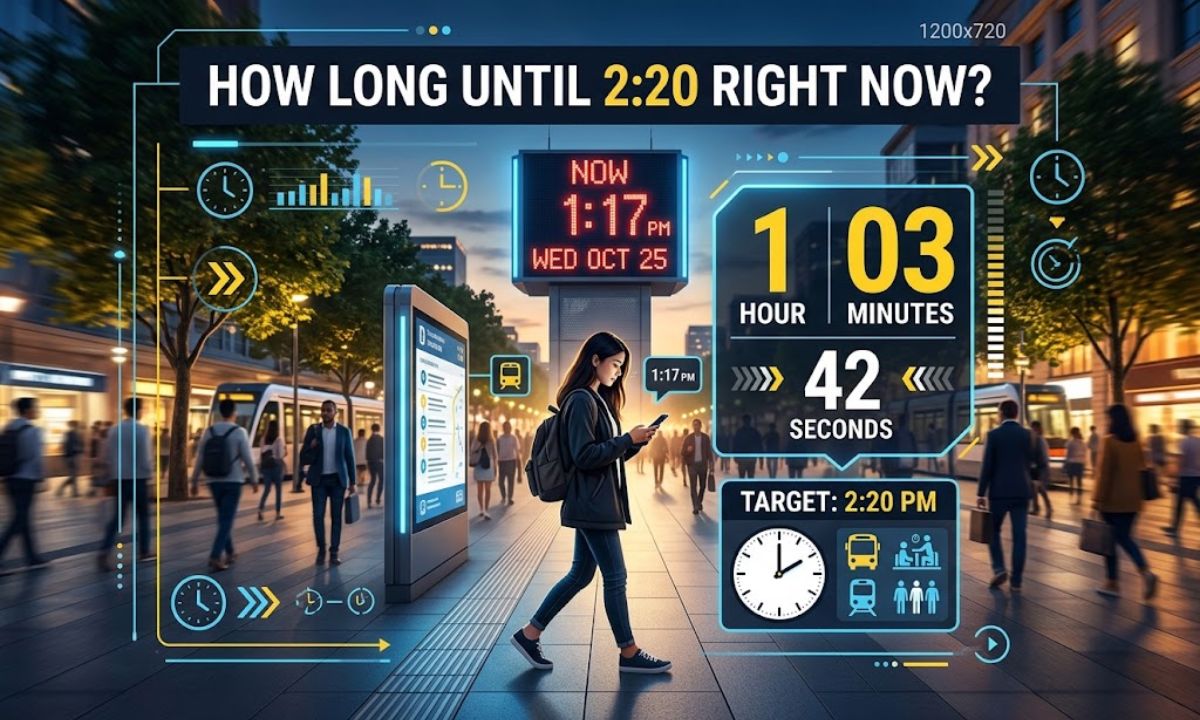
The answer is 2:20 minus your current time, and only your own clock can supply that second number. Nobody can read it for you, so a quick calculation is the most reliable route.
Follow these four steps:
- Note the current time on your clock or phone.
- Count the minutes left until the next full hour.
- Add the whole hours between that hour and 2:00.
- Add the final 20 minutes.
Here is a live example. It is 1:47 and you want 2:20. The next full hour is 2:00, which is 13 minutes away. Add 20 and you get 33 minutes.
Read More: How Long Until 2:10? Quick Ways to Calculate the Time Left
The Total Minutes Method
Converting everything to minutes removes most of the guesswork. Multiply the hours by 60, add the minutes, and subtract the smaller number from the larger one.
Try it with 9:35 AM and a 2:20 PM target:
- 9:35 AM equals 575 minutes after midnight.
- 2:20 PM equals 14:20, which is 860 minutes.
- The gap is 285 minutes, or 4 hours and 45 minutes.
This method shines when the wait is long. It also works the same way every time.
Countdown Chart to 2:20 PM
This chart shows the wait to 2:20 PM from common start times on the same day. Find the row closest to your current time and adjust by a few minutes.
| Current time | Time left until 2:20 PM |
| 8:00 AM | 6 hours 20 minutes |
| 10:00 AM | 4 hours 20 minutes |
| 11:30 AM | 2 hours 50 minutes |
| 12:00 PM | 2 hours 20 minutes |
| 12:30 PM | 1 hour 50 minutes |
| 1:00 PM | 1 hour 20 minutes |
| 1:30 PM | 50 minutes |
| 1:45 PM | 35 minutes |
| 2:00 PM | 20 minutes |
| 2:10 PM | 10 minutes |
| 2:19 PM | 1 minute |
Say your clock reads 12:45 PM. That sits between the 12:30 and 1:00 rows, so the wait falls between 1 hour 50 minutes and 1 hour 20 minutes. The exact answer is 1 hour 35 minutes.
How to Count When You Are Close to 2:20
When you are within two hours of 2:20, a simple rule does the job. Between 1:00 and 1:59, the wait equals 80 minus the minutes on the clock.
At 1:47, that is 80 minus 47, which gives 33 minutes. At 1:20, it is 80 minus 20, so you wait 60 minutes. At 1:05, you wait 75 minutes.
Between 2:00 and 2:19, the rule gets even easier. Subtract the minutes from 20. At 2:12, you have 8 minutes left.
Why 80? Because 1:00 to 2:20 is one hour and twenty minutes, and that adds up to 80 minutes. Once you see the pattern, you can do these in your head while walking to a meeting.
What Happens When It Is Already Past 2:20?
If 2:20 has just passed, the next one is either about 12 hours away or about 24 hours away. A clock shows a 2:20 twice a day, once in the small hours and once in the afternoon.
Here is the wait to each one from a few evening start times:
| Current time | Until next 2:20 AM | Until next 2:20 PM |
| 2:30 PM | 11 hours 50 minutes | 23 hours 50 minutes |
| 6:00 PM | 8 hours 20 minutes | 20 hours 20 minutes |
| 9:00 PM | 5 hours 20 minutes | 17 hours 20 minutes |
| 11:10 PM | 3 hours 10 minutes | 15 hours 10 minutes |
Take 11:10 PM as a worked case. The stretch to midnight is 50 minutes. Midnight to 2:20 AM is another 2 hours and 20 minutes. The total is 3 hours and 10 minutes.
That midnight jump is where most people slip. Split the trip at 12:00 and add the two pieces.
2:20 AM vs 2:20 PM
The two times sit exactly 12 hours apart, so always confirm which one you mean. On a 24 hour clock, 2:20 AM reads 02:20 and 2:20 PM reads 14:20.
This matters more than you might think. Someone who says “meet me at 2:20” almost always means the afternoon. A night shift worker, a flight crew member, or a new parent awake with a baby may mean the overnight one.
Here is a short way to keep them straight:
- AM covers midnight up to noon.
- PM covers noon up to midnight.
- Add 12 to any PM hour to get the 24 hour version.
If you use 24 hour time, the math gets simpler. From 09:35 to 14:20, subtract directly. You never have to think about AM or PM at all.
Do Time Zones and Daylight Saving Change the Answer?
Yes. If the 2:20 belongs to another time zone, convert it to your local time first. Then do the subtraction as usual.
A quick example helps. A webinar starts at 2:20 PM Eastern. That equals 11:20 AM Pacific. If you are on the Pacific coast and it is 10:50 AM, you wait 30 minutes.
Daylight saving adds a strange twist in most US time zones:
- In spring, clocks jump from 2:00 AM to 3:00 AM. That night, 2:20 AM never happens.
- In autumn, clocks fall back from 2:00 AM to 1:00 AM. That night, 2:20 AM happens once, and 1:20 AM happens twice.
So if you count down to an overnight 2:20 on one of those two nights, your total can be off by an hour. Most phones adjust on their own, so trust the phone over your mental math on those dates.
Easy Ways to Get an Instant Countdown
The best method is the one you never have to calculate. Your phone already has several tools that do the counting for you.
Pick whichever suits you:
- Alarm: Set an alarm for 2:20. It rings at the right moment, and you can glance at the alarm screen to see the time remaining.
- Timer: Work out the minutes with the chart above. Enter that number and let the timer run.
- Voice assistant: Ask it to set a timer or alarm for 2:20. Say AM or PM to avoid mix ups.
- Smartwatch: A wrist alert is hard to miss and works when your phone is in a bag.
- Computer calendar: Add a reminder at 2:20 with a five minute warning.
For a one time task, a timer is quick. For something that repeats daily, an alarm with a repeat setting saves effort. Paper notes still work too, since a sticky note on a monitor never runs out of battery.
Where a 2:20 Countdown Comes in Handy
People count down to 2:20 for many everyday reasons. The most common ones are simple.
- School dismissal: Many schools release students in the early afternoon. Parents time pickup runs to the minute.
- Work shifts: A shift may end at 2:20 PM after an early start. Workers watch the last stretch closely.
- Meetings and calls: A call at 2:20 gives people ten minutes after a 2:10 wrap up. Precision keeps schedules tidy.
- Cooking and baking: A dish that needs 45 minutes in the oven gets pulled at 2:20 if it went in at 1:35.
- Travel: A bus or train departing at 2:20 leaves no room for guessing.
- Medication reminders: Some routines call for a dose at a set time. Accuracy matters there, so use an alarm and not mental math.
In all these cases, the same subtraction applies. Only the reason for waiting changes.
Common Mistakes to Avoid
Most wrong answers come from a handful of predictable errors. Watch for these.
Treating Minutes Like Decimals
An hour has 60 minutes, not 100. From 1:30 to 2:20, the wait is 50 minutes. Some people subtract as if 2.20 minus 1.30 equals 0.90 and read that as 90 minutes. That answer is wrong.
Mixing Up AM and PM
A 12 hour error is the biggest mistake possible. If it is 3:00 PM and you want 2:20 AM, you wait 11 hours and 20 minutes. If you wanted 2:20 PM, you wait 23 hours and 20 minutes. Always name the half of the day.
Forgetting to Cross Midnight
When the target time is on the other side of midnight, the simple subtraction breaks. Split the trip at 12:00, calculate both halves, and add them.
Ignoring Time Zones
A meeting listed as 2:20 without a zone label can mean very different things. Ask which zone it uses before you count anything.
Rounding Too Early
If you round 13 minutes to 15, you lose two minutes. That gap can make you late. Keep the exact numbers until the very end.
Quick Tips for Faster Mental Math
A few habits make these calculations feel automatic. Practice them for a week and you will barely think about it.
- Anchor to the nearest full hour. Every trip to 2:20 is a jump to 2:00 plus 20 minutes.
- Memorize 80. From 1:00, the wait is always 80 minutes.
- Say the answer out loud. Hearing “thirty three minutes” helps you catch strange results.
- Double check with the total minutes method when the stakes are high.
- Set a backup alarm five minutes before 2:20 so a small error never costs you.
Frequently Asked Questions
What is the fastest way to find how long until 2:20?
Subtract the current time from 2:20, or set a phone timer or alarm for 2:20 and let it count for you.
How many minutes until 2:20 from 2:00?
It is exactly 20 minutes. The same holds for any hour, so 4:00 to 4:20 is also 20 minutes.
How long is it from 2:20 AM to 2:20 PM?
It is 12 hours. Both times sit on opposite halves of the same day.
What is 2:20 PM in 24 hour time?
It is 14:20. Add 12 to the hour for any PM time.
How long until 2:20 if it is already 2:30 PM?
The next 2:20 AM is 11 hours and 50 minutes away. The next 2:20 PM is 23 hours and 50 minutes away.
Final Thoughts
Working out how long until 2:20 takes one subtraction, and it gets easier with practice. Move to the next full hour, add the whole hours, then add the last 20 minutes. Convert to total minutes when you need extra confidence.
Check AM and PM, watch for midnight, and confirm the time zone. When accuracy matters, hand the job to a timer or alarm. Your clock does the counting, and you get to do something more useful with the wait.

Henry Collins is a dedicated writer with 4 years of experience creating engaging and informative content.
He specializes in travel, lifestyle, and personal development topics, turning ideas into clear and practical advice.
His writing is well-researched, reader-friendly, and focused on delivering real value.
Henry is passionate about inspiring readers with authentic and meaningful content.