


The answer depends on what your clock shows right now. Subtract the current time from 12:50 to get the minutes and hours left. If it is 12:00, you have 50 minutes to go.
This guide shows you the fastest ways to work it out. You will find worked examples, a handy chart, and tips to avoid the usual slip ups. Keep reading and you will never need to count on your fingers again.
Quick Facts About 12:50
| Detail | Info |
| Time in 12 hour format | 12:50 AM or 12:50 PM |
| Time in 24 hour format | 00:50 or 12:50 |
| Minutes before 1 o’clock | 10 |
| Minutes past noon (PM) | 50 |
| Minutes past midnight (AM) | 50 |
| How often it happens | Twice every day |
| Spoken form | Ten to one |
How Long Until 12:50 Right Now?
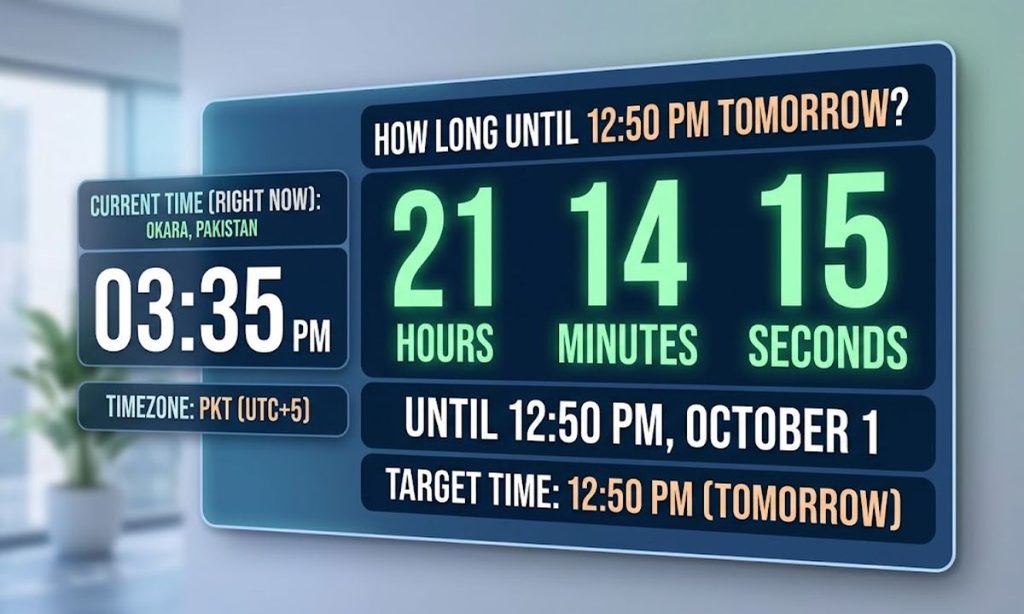
Check your clock, then subtract it from 12:50. That gap is your answer.
A site cannot show your exact countdown, because your local time changes every second. Your phone, watch, or computer knows the time. You only need a small bit of math.
Here is the short version:
- Look at the current time.
- Decide if you mean 12:50 AM or 12:50 PM.
- Subtract the current time from 12:50.
- Add 24 hours if 12:50 has already passed today.
That is the whole method. The next sections break it down.
How to Calculate the Time Until 12:50
You find the time left by subtracting your current time from 12:50. Do the hours first and then the minutes. If the minutes do not fit, borrow one hour.
The Simple Subtraction Method
This method works when your current minutes are 50 or less.
Take it from 9:20. Subtract the hours: 12 minus 9 is 3. Subtract the minutes: 50 minus 20 is 30. You have 3 hours and 30 minutes.
Try 11:10. Hours: 12 minus 11 is 1. Minutes: 50 minus 10 is 40. The wait is 1 hour and 40 minutes.
Easy enough. Things get trickier when the minutes are bigger than 50.
The Borrow Method
Use this when the current minutes are higher than 50.
Say it is 8:55. You cannot take 55 from 50. So borrow one hour and turn it into 60 minutes. Now 50 becomes 110 minutes, and 12 hours becomes 11 hours.
Subtract again. Hours: 11 minus 8 is 3. Minutes: 110 minus 55 is 55. You wait 3 hours and 55 minutes.
It feels odd the first time. After two or three tries it becomes automatic.
The Count Up Method
This one is great for mental math. Start at your current time and climb to 12:50 in easy jumps.
From 10:35, jump to 11:00. That is 25 minutes. Jump to 12:00. That is 60 more. Jump to 12:50. That is 50 more. Add them up: 25 plus 60 plus 50 is 135 minutes. That equals 2 hours and 15 minutes.
Many people like this method because each jump is small. It also works well when you are tired or in a rush.
Read More:How Long Until 3:35? Easy Ways to Find the Exact Time Left
Time Left Until 12:50 From Common Starting Points
Here is a quick chart you can scan. It assumes the current time is earlier than 12:50 and that you are counting toward the same 12:50.
| Current Time | Time Until 12:50 |
| 12:49 | 1 minute |
| 12:45 | 5 minutes |
| 12:40 | 10 minutes |
| 12:30 | 20 minutes |
| 12:20 | 30 minutes |
| 12:00 | 50 minutes |
| 11:50 | 1 hour |
| 11:30 | 1 hour 20 minutes |
| 11:00 | 1 hour 50 minutes |
| 10:15 | 2 hours 35 minutes |
| 9:00 | 3 hours 50 minutes |
| 8:30 | 4 hours 20 minutes |
| 6:00 | 6 hours 50 minutes |
| 3:00 | 9 hours 50 minutes |
| 1:00 | 11 hours 50 minutes |
Notice the pattern. Every full hour on the clock leaves you with a gap that ends in 50 minutes. That shortcut saves a lot of mental effort.
12:50 AM vs 12:50 PM: What Is the Difference?

12:50 AM is 50 minutes after midnight. 12:50 PM is 50 minutes after noon. They sit exactly 12 hours apart.
This matters a lot. Mixing them up can make you early by half a day. Or very late.
12:50 AM
This is the middle of the night. Most people are asleep. It shows up in late shift schedules, overnight flights, and early morning alarms.
12:50 PM
This is just after lunch starts for many people. It appears on class timetables, appointment slips, and meeting invites. It is the more common version in daily life.
Why the Confusion Happens
The 12 hour clock restarts at 12, not at 1. So 12:00 AM is midnight and 12:00 PM is noon. Many people expect noon to be “12 AM” because it feels like the start of something. It is not.
If you want zero confusion, switch to the 24 hour format. In that system, 12:50 PM is written as 12:50 and 12:50 AM is written as 00:50. No guessing required.
How Long Until 12:50 Tomorrow?
If 12:50 has already passed today, add the time left today to the time from midnight to 12:50. Or simply subtract your current time from 36 hours and 50 minutes, depending on how you set it up. The first approach is easier.
Here is a clean way to do it:
- Find the time left until midnight.
- Add 12 hours and 50 minutes if you want 12:50 PM tomorrow.
- Add 50 minutes if you want 12:50 AM tomorrow.
Example: it is 3:00 PM and you want 12:50 AM tonight. Time to midnight is 9 hours. Add 50 minutes. The total is 9 hours and 50 minutes.
Another one. It is 1:10 PM and you want 12:50 PM tomorrow. Time to midnight is 10 hours and 50 minutes. Add 12 hours and 50 minutes. The total is 23 hours and 40 minutes.
A neat trick helps here. The gap between any time and the same time tomorrow is always 24 hours. So subtract 20 minutes from 24 hours when the current time is 20 minutes past 12:50. That gives you 23 hours and 40 minutes, the same answer.
Quick Ways to Check the Countdown
The fastest way is a timer on your phone. Set it for the number of minutes you calculated. It will alert you right on time.
Other options work just as well:
- Voice assistants: Ask your phone or smart speaker to set a timer or an alarm for 12:50.
- World clock apps: Add your city and check how far away 12:50 is.
- Alarm apps: Set a one time alarm for 12:50 and let it count down for you.
- Smartwatches: Most have a countdown or reminder feature built in.
- Calendar reminders: Add an event at 12:50 with a notification five minutes before.
If you only need a rough idea, glance at the clock and round. At 11:40, you have about an hour and ten minutes. Close enough for most plans.
Time Zones and Daylight Saving
Time zones change your answer. A person in London and a person in New York see different clocks, so their gaps to 12:50 differ.
Always confirm which time zone the 12:50 belongs to. A webinar listed at 12:50 PM Eastern is not 12:50 PM for someone in Pacific time. For them it is 9:50 AM.
Daylight saving can also shift things. On the day clocks move forward, an hour disappears. A countdown that normally takes 6 hours may feel like 5. On the day clocks move back, you gain an extra hour.
Many regions do not use daylight saving at all. If you travel or work with global teams, double check the date and the offset. A quick search for the time zone difference between two cities takes seconds and saves real trouble.
Common Mistakes When Counting to 12:50
Most errors are small and easy to avoid. Here are the top ones.
- Forgetting to borrow: When minutes are higher than 50, you must take one hour and add 60 minutes. Skipping this gives a wrong answer by a full hour.
- Treating 100 as a minute limit: Time is not decimal. One hour has 60 minutes, not 100.
- Mixing AM and PM: A 12 hour mistake is the most expensive one.
- Ignoring the date: If 12:50 has passed, the next one may be tomorrow.
- Forgetting the time zone: The same number on a clock can mean different moments around the world.
- Rounding too early: Do the full math first. Round only at the end.
A small habit helps. Say the answer out loud in plain words. “From 10:35 to 12:50 is two hours and fifteen minutes.” If it sounds wrong, check it again.
When Does Knowing the Time Until 12:50 Help?
Counting down to 12:50 is useful more often than you might think. Many daily schedules sit close to it.
Some common cases include:
- Class changes: Many schools run lunch and period breaks around this window. Students often track the gap to the next bell.
- Meetings: A call at 12:50 PM fits right after a lunch hour. People plan the morning around it.
- Transport: Buses, trains, and flights sometimes leave at 12:50. Missing one by a minute stings.
- Medication and routines: Some people take doses at set times. A countdown keeps them on track.
- Late shifts: A 12:50 AM clock out or call time is common in hospitality and logistics.
In each case, the same simple subtraction applies. Learn it once and it works every time.
Easy Tips for Faster Time Math
A few tricks make the process nearly instant.
- Use 12:50 as ten to one. Count the time until 1:00 and then take off 10 minutes.
- Think in landmarks. Jump to the next full hour. Then count hours. Then add 50 minutes.
- Convert to minutes. Turn both times into minutes after midnight and subtract. 12:50 PM equals 770 minutes. 9:00 AM equals 540 minutes. The gap is 230 minutes, or 3 hours and 50 minutes.
- Check with a clock face. Picture the minute hand. Ten minutes before the top is the 10 mark.
- Double check with a timer. Run a countdown on your device to confirm.
The “ten to one” trick is the one most people stick with. It turns an awkward number into a friendly one.
Frequently Asked Questions
How many minutes are left until 12:50 if it is 12:00?
There are 50 minutes left. You simply subtract 12:00 from 12:50.
What time is ten minutes before 12:50?
That is 12:40. Go back ten minutes from 12:50 on the clock.
Is 12:50 AM the same as 00:50?
Yes. In the 24 hour format, 12:50 AM is written as 00:50.
How long is it from 12:50 AM to 12:50 PM?
It is exactly 12 hours. Noon sits right in the middle of that stretch.
Why does 12:50 happen twice a day?
The 12 hour clock repeats twice in 24 hours. So 12:50 appears once after midnight and once after noon.
Conclusion
Working out how long until 12:50 comes down to one move. Subtract your current time from 12:50, and borrow an hour when the minutes do not fit. Always check whether you mean AM or PM.
Keep the chart handy for quick answers. Use a timer when you need a reliable alert. With a little practice, you will answer “how long until 12:50” in a few seconds, with no stress and no second guessing.

Henry Collins is a dedicated writer with 4 years of experience creating engaging and informative content.
He specializes in travel, lifestyle, and personal development topics, turning ideas into clear and practical advice.
His writing is well-researched, reader-friendly, and focused on delivering real value.
Henry is passionate about inspiring readers with authentic and meaningful content.